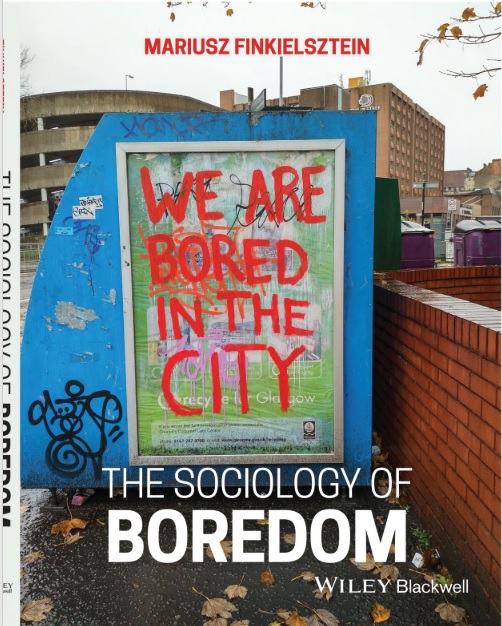
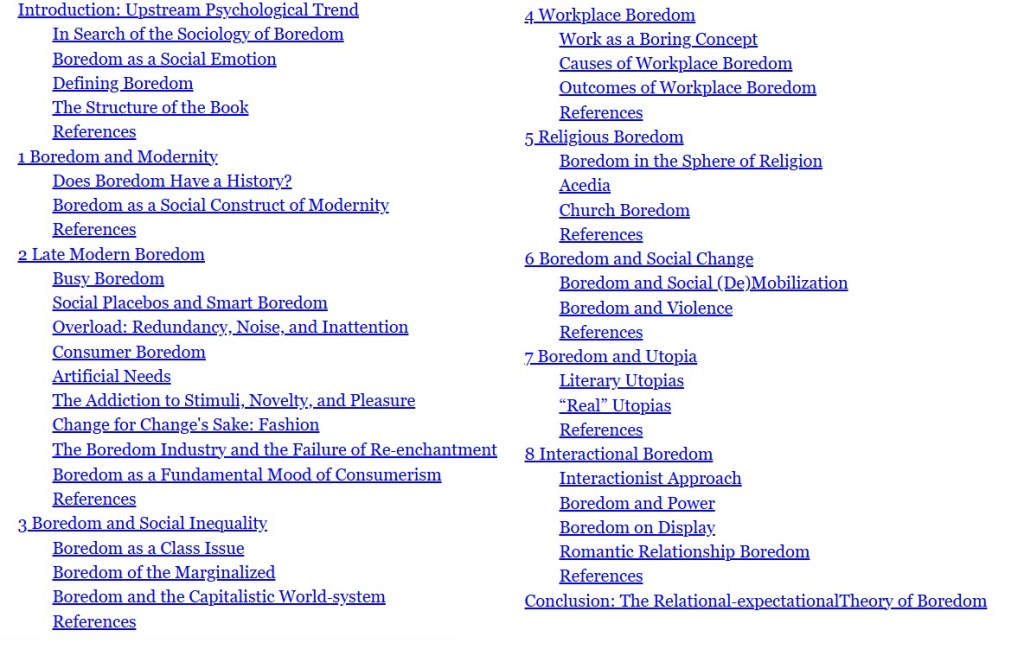
My second book summarises 13 years of researching and theorizing about boredom. It adds a sociological perspective to boredom studies, analyzing boredom from various vantage points and touching upon different spheres of social life to propose relational-expectational theory of boredom.
Does boredom have a history?
What can hunter-gatherers teach us about boredom?
Is boredom experienced differently by those in different socio-economic classes?
Is boredom a disease that is now globalized in a world of inequalities and marginalization?
Does boredom contribute to political movements, wars, terrorism, or cultural revolutions?
What does boredom have to do with power?
How do high expectations contribute to being recurrently bored?
Here you can find table of contents: https://onlinelibrary.wiley.com/doi/book/10.1002/9781394253364
The presentation of relational-expectational theory of boredom at the 6th International Interdisciplinary Boredom Conference.
 MARIUSZ FINKIELSZTEIN, Ph.D.