The article below is an updated version of the paper originally published in Polish: Finkielsztein, M. (2016). Projekt wspólnoty chrześcijańskiej w „Kobiercach” Klemensa Aleksandryjskiego [Project of Christian Community in „Stromata” by Clement of Alexandria]. Teologia i Człowiek, 36(4), 199-220. http://dx.doi.org/10.12775/TiCz.2016.051
- 1. INTRODUCTION
- 2. THE PERSONAL MODEL OF A CHRISTIAN
- 3. THE VISION OF CHRISTIAN COMMUNITY
- 4. CONCLUSION
- Bibliography
1. INTRODUCTION
Clement of Alexandria (c. 150- c. 215) was one of the first Church fathers, an early Christian theologian, certainly an extraordinary figure, although little known outside the circle of specialists. In the memory of posterity, he was often overshadowed by his controversial disciple, Origen. Clement is the author of mainly didactic works, the most important of which is the educational trilogy consisting of the writings: “Exhortation to conversion” (Protretikos), “Tutor” (Paidagogos), and the Stromata or Stromateis (which means “carpets”). Its successive parts refer to the successive stages of reaching holiness and perfection. They are, in turn, conversion, upbringing, and teaching, aimed at deepening the individual’s virtues and finally shaping the individual as a conscious Christian. The work that was the main inspiration for this work, Stromateis, or Miscellanies or notes of revealed knowledge in accordance with the true philosophy,[i] was to correspond to this last stage of Christian development. It is a collection of unsystematic and often inconsistent notes on various topics related to being a Christian and Christianity in general. According to the logic of the three stages of development, this work should be titled The Teacher (Didaskalos), but Clement rejected this title.[ii] Considering the lack of consistency and the disorganized structure of the work, scholars have supposed that Stromateis may have been “a collection of notes, notes or materials, which Clement intended to use in the final editing of the future Didaskalos.”[iii]
As an educated man, Clement frequently lamented the low intellectual level of Christianity and Christians of his time. In his Stromateis he often makes use of pagan writings, above all works of philosophers (including the Stoics, Plato, Aristotle, and Epicurus) as well as poets and playwrights. Philosophy, according to his conception (borrowed from Philo of Alexandria), is a plagiarism of the Old Testament and as such is a gift given by God to the Greeks.[iv] It constitutes a certain substitute for the teachings of Christ, a surrogate of salvation, thanks to the supreme principle that constitutes it, namely the Logos. He polemicises thereby with those among Christians who saw philosophy as the work of the devil and believed that “But God hath chosen the foolish things of the world to confound the wise”.[v] He wanted to show both the pagans, who criticised Christianity for its anti-intellectualism, as well as the doubters, educated and gnosis-inclined Christians, that faith can be combined with knowledge and the pursuit of wisdom and, consequently, that the ideal of the Christian philosopher is not only possible but also desirable.
Stromateis is a kind of guide to Christianity for educated people (i.e., those familiar with the works of classical authors). It was intended to help them create a coherent identity narrative and to guard against the errors of the Gnosticism that was spreading at the time. In Stromateis, Clement speaks on both doctrinal and deeply practical topics, such as marriage, martyrdom, the characteristics of the ideal Christian, the values that build Christian identity, etc. In his erudite work, Clement is a great defender of the body[vi] and marriage (following his work, support for carnal ascetism and virginity increased); he recommends the affirmation of creation, which becomes an important step on the road to salvation, as those who love themselves love God (cf. IV.42.5). He also speaks on the question raised by St. Paul concerning the criteria of recognizing someone as a Christian, by establishing the category of Christians “by name” (IV.17.1-4). His work was part of an emerging current of Christian writing attempting to intellectualise the religion of Christ and reconcile it with the material world (Tertullian, Clement of Rome and others). The results of these investigations are still visible today in the teaching and rhetoric of the Church.
In his work Clement focuses on individual manifestations of the Christian attitude—he projects ascending a Christian through faith, love, and knowledge to “sonship with God” (VII.68.1), i.e., to ultimate unity with Christ-Logos (homoiosis Theo).[vii] In this paper, I would like to show the social implications of Clement’s thought—to reconstruct his vision of Christian community. As I will try to demonstrate, community is what actually constitutes the ultimate conclusion, and probably also a goal, of Clement’s construction. He creates a reasonably coherent, albeit chaotically expressed,[viii] project of Christian community, in which, however, the question of the relationship between the individual, especially the outstanding one, and the community seems yet unclear. How are the outstanding individuals supposed to influence the community, what relation are theysupposed to have to it, and do they have a monopoly on the certainty of salvation? In the paper, I suggest that Clement’s vision of perfection does not only include gnostic, as a model Christian, but the community as well, and that his ultimate goal is actually a community of gnostics, tightly connected with God and with one another. In that sense, Stromateis implicates a vision of Christian utopia, re-achievement of a paradise-like state of unity with God on the level of community. The presented analysis is based almost solely on the text of Stromateis and constitutes my interpretation of Clement’s concepts. I devote much less attention to the historical and literary sources of Clement’s thought, his Christology, or various theological issues—they are competently described in the relevant literature. In the article, I will focus solely on the sociological implications of Clement’s vision of the gnostic and his relationship with the Christian community.
2. THE PERSONAL MODEL OF A CHRISTIAN
Clement recognises an outstanding individual (the Gnostic) as a personal model for the whole community, which should strive to become like him in all its tissues. It is therefore necessary to begin with a brief description of Clement’s vision of the ideal Christian. The basic desirable attributes of a Christian are the virtues. The main principle guiding their relationship is the principle of coexistence.[ix] According to Clement, the virtues are closely linked together in one indissoluble chain (II.80.2-3; cf. also II.45.1; IV.59.2; IV.163.3), they remain in mutual relationship with each other, forming strong relations of inference like tissues in one organism. The basic virtues, according to him, are faith, fear of God, and the Law. Clement calls faith “the mother of the virtues” (II.23.5), the principal basis of all of them,[x]the voluntary initial acceptance, “preconception by the will” (II.8.4) of mental union with the unknowable, and salvific transformation (VII.57.4). In his vision, faith constitutes the first, indispensable link in the chain and the initial step on the path leading to truth and salvation.
The fear of God is the second step on the road to salvation. Fear of God is not something primary like the fear of death, but results from a relationship of dependence. God is a superior whose Laws we fear to oppose and a Father whom we fear to disappoint. Our feelings towards him are a kind of timor reverentialis, a respectful fear; thus, it is closely linked to compliance with the rules established in this relationship (see II.53.4). The relationship to God combines closeness and distance, love and fear, which is essentially the fear of falling away from God (that is, from the Good), from losing his grace (the benefits of participation in his community of values).
An important element constituting the behavioural patterns and attitudes of a Christian is the Law, the observance of which is a virtue equal to the two previously discussed. It shows the direction of further improvement and provides help and encouragement to remember the truth and to express it clearly. Together with the fear of God, it leads to wisdom, self-control and love.[xi]
The above-mentioned virtues are meant, according to Clement, to lead the individual to gnosis [knowledge], which is “a perfecting of man as man, [that] is consummated by acquaintance with divine things, in character, life, and word” (VII.55.1). In other words, it expresses itself in the way of thinking, mode of life and expression. Knowledge provides the sure and unquestionable evidence of the presuppositions assumed by faith and, ultimately leads one to a conviction no longer refutable and based on “scientific” certainty (cf. VII.57.3). The ideal, however and supreme value is the gnostic agape.
2.1. GNOSTIC – A MODEL CHRISTIAN
A fundamental feature of the Gnostic attitude, which is also a key characteristic of the Christian in general, is voluntariness and consciousness. Entering into the way of Christ’s teachings cannot be motivated by a desire for reward or the desire to avoid punishment, but only the will to know God, the intention to participate in his everlastingness. The Gnostic wants to know the supreme Good for its own sake and does good in order to achieve moral beauty.[xii]
Could we, then, suppose any one proposing to the Gnostic whether he would choose the knowledge of God or everlasting salvation; and if these, which are entirely identical, were separable, he would without the least hesitation choose the knowledge of God, deeming that property of faith, which from love ascends to knowledge, desirable, for its own sake (IV.136.5).
The gnostic path is thus a constant striving towards the virtues and, through them, towards knowledge: “It is not then possible that man or woman can be conversant with anything whatever, without the advantage of education, and application, and training; and virtue, we have said, depends not on others, but on ourselves above all” (IV.124.1-3, cf. II.69.2). Thus, he agrees with the Stoics in claiming that virtue is something that can be learned and the exercise and improvement of which is volitional.
In essence, everyone has an equal chance of perfecting the virtues and salvation, due to the identity of nature in all people, which is inclined both to sin and to the cultivation of the virtues.[xiii] It is therefore possible to become a Gnostic regardless of age or gender. It is also independent of the education of the individual. As Clement claims, it is permitted for everyone living in the community to strive for wisdom, even without education (IV.58.3). In another place, however, he asserts that the first level of salvation is education (IV.53.1). It seems that these discrepancies can be explained by rhetorical considerations—Clement adapts his theses to the particular purpose of a given paragraph. However, it seems that education is necessary for salvation in the Gnostic way. The author of Stromateis lists five possible paths leading to salvation: the way of the pious, of the temperate, of the industrious, of the martyr, and of the Gnostic. The last one is the most recommended, but it is not for everyone, because combining all the other paths.[xiv] it requires the greatest effort of will. Everyone should strive for perfection on the path to which they have been called, because only by this path can they reach salvation.
The essence of the Gnostic way is the cultivation of virtues, for which the basis is the Stoic principle of apatheia, which recommends suppressing all unintelligent desires that interfere with happiness, detracting from things truly worth knowing.[xv] Apatheia is the goal of all aspirations of the Gnostic, which should result in perfect identification, i.e., being knowledge itself (IV.40.1). The Gnostic is not a full embodiment of the moral ideal, however, since no human being can in his lifetime achieve perfection in every respect (IV.130.2).[xvi] Clement, in his views on Gnostic affectlessness, is so radical that he rejects the concept of eupatheia of the moderate Stoics and claims that the Gnostic should not have to deal with any emotional states, since there are none in their collection which can be evaluated positively (VI.74.2; VI.72.2-73.1). Hence also his view of the essence of agape, which he not only does not recognise as an affect, but distinguishes it as superseding all affects (VI.71.4).
The aim of all these endeavours is to be conformed to God (see, e.g., II.103.1). The Gnostic should remain in a saving disposition, that is, to keep reason in a state of complete and unchanging quality (II.139.4). For this reason he will not desire mundane fame or seek external prosperity and “never then have the chief end placed in life, but in being always happy and blessed, and a kingly friend of God” (IV.52.2). The Gnostic is a friend of God and his servant at the same time.
2.2. GNOSTIC – A FRIEND OF GOD
Clement compares the Gnostic’s relationship with God to a return to man’s perfect harmony with the Creator as in the Garden of Eden. He expresses this by writing that the Gnostics will be restored to the state of the longed-for sonship with God (IV.40.3; cf. VI.75.2) The term “garden” was used by Clement to construct a plant metaphor in which the man-plant must be “transplanted” from the old life into the soil of truth, “planted in Christ” (that is, transferred into a new environment of virtues and their corresponding values) away from the old way of life (cf. VII.27). In such soil alone can the gnostic develop and become more like God. The position of the Gnostic towards God is clearly explained by Clement distinguishing three degrees of initiation. At first, just after conversion, a Christian is only a servant (δούλος), a slave of sins. With time, he learns the Christian teachings and becomes a faithful servant (πιστός). As he approaches perfection, he becomes a friend of God (φίλος), who shares in his mysteries. The evolutionary character of the Christian attitude is well illustrated by the words in the Gospel of St John, spoken by Jesus, saying that he is the way, the truth and the life (J 14:6). To these three pronouncements it is easy to attribute Clement’s three “developmental” stages of the Christian. First, he sets out on a journey, learning about the teachings of Jesus, then he comes to knowledge thanks to them, in order finally to put its effects into action. He thus opposed the doctrines of the Gnostics, who “claimed to be able to bypass, through a moment of instant “redemption,” the long moral and intellectual discipline required of every Christian”.[xvii]
2.3. GNOSTIC – AN INCARNATION OF AGAPE
The Gnostic, through the divine agape, is established in God (VI.102.1) and totally oriented towards him (VI.71.4). Through this he sets his life on the same frequency as the rhythm of the divine life. He comes out of the Platonic cave, he is able to see the ideas, he becomes like the Stoic sage who reaches a state of equality with the gods, he becomes their ally. Clement explains the revelation contained in the pagan conception by writing that reason is the seat of ideas, reason is God (cf. J 1,1). So Plato called those who can see the invisible God “gods living among men” (IV.24; 155.2; cf. Plato, Sophist 210 B-C).
From these facts Clement draws practical conclusions, writing that “the attachment to intellectual objects naturally becomes to the Gnostic an influence which draws away from the objects of sense” (IV.148.1). The Gnostic is close to God through agape [love], which is “the bond of perfectness” (Col 3:14 according to KJ21). As Drączkowski writes:
If we were to stick to the metaphor according to which the virtues were supposed to be, to be individual garments or parts of a garment, then agape would not be one of the many “dresses,” but a “girdle,” a “lace,” an “up-do girdling,” “knotting,” “fastening the garments,” a belt that binds everything together, something that makes the garment complete and utter.[xviii]
Agape thus appears as the apogee of the virtues, as the element which gives the shape of the whole, but also as a virtue that directs all others towards an ultimate goal, i.e., a functional link between the Gnostic and the “Highest Perfection.”
However, all this does not negate the Gnostic’s participation in the earthly community. Although he consciously moves away from people in order to be closer to God, nevertheless, “abiding in a supernatural and natural existence is happy and joyful thanks to agape, which, by dynamising and enabling him to act well in earthly reality, at the same time unites him with the community of divine life, already giving him participation in the happiness of the life to come.”[xix] Fulfilment in the relationship with God gives him strength and motivation for activity on earth, which, according to Clement, consists of being an average member of the community, a husband and a father:
one is not really shown to be a man in the choice of single life; but he surpasses men who, disciplined by marriage, procreation of children, and care for the house, without pleasure or pain, in his solicitude for the house has been inseparable from God’s love, and withstood all temptation arising through children, and wife, and domestics, and possessions (VII.70).
The Gnostic, thanks to the divine agape, “combines the ideal of the inner life with the practical life.”[xx] He is not a misunderstood sage, but an older, more experienced member of the community—he constitutes its quintessence.
3. THE VISION OF CHRISTIAN COMMUNITY
The community is not a collection of individual units, it is not a simple sum of its parts. Christianity has had such a strength and flourished, despite many adversities, precisely because it created a new ideal of community, based on voluntary and conscious participation, the idea of solidarity and a community of values. This model of community was very attractive—it was an open relationship, which distinguished it from the majority of previously existing religious communities. There were no preconditions—anyone could become a Christian as long as he expressed a desire to join, which was demonstrated by conversion. In Clement’s vision, the Christian community is a community of freedom in which participation is entirely voluntary, a value in itself and the highest good.
3.1. THE ARISTOTELIAN COMMUNITY OF PERFECTIONISTS
The community, like the individual, is on a continuous journey towards perfection. The stages on this journey can be graphically represented as a series of chains.
Table 1. Degrees of self-improvement according to Clement
| Stages | Conversion – birth, childhood | Education – Adolescence | Teaching – Maturity |
| Groups | Slaves, servants | Faithful servants | Gnostics |
| Degrees of Advancement | Neophytes | Regular believers | Model Christians |
| Virtues | Faith | Fear, Laws | Agape, Gnosis |
| Motivations | Punishment/Reward | Obedience | Agape |
The Christian community is constantly maturing into the sonship with God and is in a state of salvific transformation(VII.57.4). Every individual wishes to come closer to the ideal and to secure his eternal happiness. But there is no happiness of the community without the happiness of each citizen of the “Church of God,” which on earth is achieved only in part, through the possibility of striving for the imperishable. A Christian is born through baptism, and grows in the process of intellectual, ethical, and social education (already postulated by Aristotle)–social, because virtue manifests itself in deeds, and each act has the character of a testimony of belonging and becomes a model of behaviour. And virtues give rise to virtues and often form extensive networks of interaction and influence. Hence the idea of chains of virtues. Virtues are connected to each other by inseparable ties, they are the projection of a principle to be valid for the whole community. Just as only the conjunction of all virtues gives certain salvation, so only within the community, i.e., with other people, the imperfect by nature (because prone to sin and weak) man can assure himself of salvation.
3.2. EQUALITY, UNITY, FRATERNITY
The community envisaged by Clement is a community of equal opportunities. There is no hierarchy in the strict sense of the word. The only element differentiating individuals remaining within the group is the degree of advancement in perfecting the virtues. There is no “caste of gnostics.” The most advanced in perfection are the “reservoirs of virtues” for the whole community. However, any believer can become such a model Christian. All people have been called to salvation and to co-create the “Body of Christ.” Unique, against the background of the epoch, was the role of women in his vision. To some extent, for many of Clement’s contemporaries, it must have come as a shock to learn that there are no typically masculine or typically feminine virtues or that “there is sameness, as far as respects the soul, she will attain to the same virtue” (IV.59.5); “woman is to practice self-restraint and righteousness, and every other virtue, as well as man, both bond and free; since it is a fit consequence that the same nature possesses one and the same virtue” (IV.60.1). From this he draws the conclusion that women, too, should have the right to exercise philosophy on an equal footing with men.[xxi] Women are therefore important members of the community and it should not be claimed that as such they do not have opportunities for self-improvement and salvation. Everyone has an equal chance of salvation; however, not everyone takes that chance, despite the fact that, as Clement points out, God “exhorts us to follow the gnostic life, and enjoins us to seek the truth in word and deed” (IV.35.1).
Perfect unity is an attributive feature of the community in Clement’s vision. This feature is constituted by common faith, Laws, common concerns and hopes, common goals, and the belt-agape that binds everything together. In a word, nothing should divide believers because too many things unite them. The Christian community is one big family that sees itself as a group of brothers and sisters, with a father in heaven who is the head of the community. The community is also distinguished by a common habitus, which enables its members to recognise each other. It is created by the Laws and the New Testament writings, and by the ethics built upon them. Common values and the resulting ethical virtues have a significant impact on the functioning of the community. The common faith is the initial motive for the homogenisation of the community, the initial condition. Common subordination to the Law becomes a truly cohesive factor, especially in situations of external threat. However, this is not a sufficient motive in itself. Then there is the fear of sin, i.e., of transgressing the Law. The community begins to be a value, as the fear of exclusion from it arises. Fear of falling away becomes a disciplinary motif, indicating the position of the individual in relation to the cosmos of community affairs. This fear built into the individual provides after some time a strong self-disciplinary mechanism. Thanks to it, the community never becomes overtly oppressive towards its members. All these factors serve to petrify the possibly ideal group’s unity. The mechanism of self-control, once set in motion, effectively prevents crimes and deviations from the group’s norms. It also develops the institution of repentance, appearing in exceptional cases of aberration. Repentance is a form of social hygiene. Repentance testifies to the conscious character of the community; it builds relations that are open and free from misunderstandings. Hence, it is another element thanks to which unity and peace remain intact. Shared hope is also important. Nothing cements a group more than a vision of a common future, especially a bright one. It is therefore a strong motivator for joint action.
Gnosis is an important cohesive element. It emphasises the ownership of something, which leads to a thickening of the intimacy of relationships. This can be well illustrated by the Aristotelian concept of friendship invoked by Clement. A community based on fear and hope is like a friendship guided by the benefits associated with cooperation. Gnosis is a prelude to Aristotelian friendship, consisting of a relationship based on the love of virtues, friendship for friendship’s sake, independent of external factors. Such relations should prevail in the Christian community. An equal relationship should prevail, which is at the same time: symmetrical (if X is a friend of Y, then Y is a friend of X), transitive (if X is a friend of Y and Y is a friend of Z, then X is a friend of Z) and reciprocal (X is a friend of X).[xxii] It can be concluded that Clement’s community should be an ideal community of friends who value each other because of their virtues. This bond is to be selfless and autotelic. The Christian community would thus be a community made up of people who are similar, equal, of the same values, and in solidarity with each other by virtue of the community of birth (baptism as re-birth) and life (habitus).
3.3. AGAPE AND ITS CONSEQUENCES
However, the most important thing constituting the community for Clement is agape. It may be said that it is both the result of all the previously mentioned virtues and factors, as well as the one that brings them all into existence and allows them to last and develop. Agape is the knot that joins man to God as well as man to man. However, it is not a direct connection. This can be illustrated by a triangle, with God at the top where the vertices at the base are two individuals. The more perfect the agape is, the lower the height of the triangle, and thus the distance between the units becomes (see Fig. 1). Hence the conclusion that the more perfect the agape, the closer the individual is to God, and the closer one is to other people. Clement at this point refers to the commandment of love contained in the Gospel of St. Matthew (Mt 22:37-39), which speaks of identifying one’s neighbour (a member of the community) with oneself. It constitutes the second “I” of the individual. Love for one’s brother includes love for God. One might say that love of neighbour is not an end, but the outcome of the divine agape.
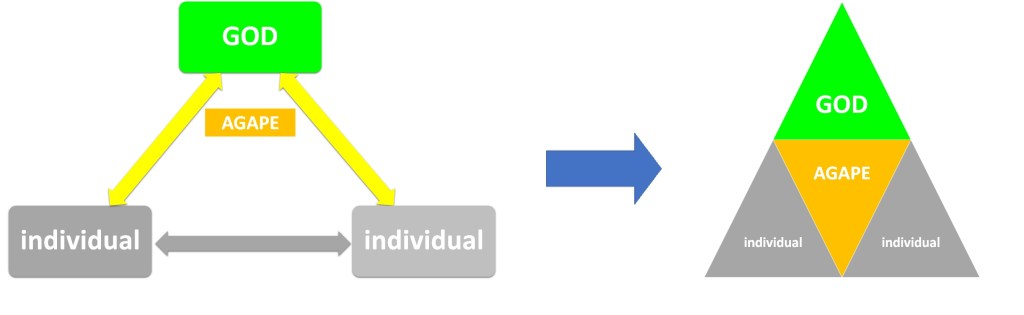
Figure 1: The micro scale. Agape is the knot connecting man with God and through him with another person (“through Christ, in Christ and with Christ”). The more perfect the agape, the closer the believer is to God. This effort ensures that the distance between people is reduced.
Above all, agape makes it impossible to sin, as it possesses the soul to such an extent that there is no room for transgression (IV.113.1). It possesses this quality by virtue of the bond with God which it creates and sustains. Agape has not only an inhibitory quality, but above all, a liberating one. It dynamises all activity on behalf of God and the community, “it is an inner fire and motor, a source of inexhaustible dynamism and inexhaustible energy, like an accumulator, connected to the divine source of energy, that is, the divine agape.”[xxiii] It is the source of all the ethical virtues that exist in the community:
Love is thought of in various forms, in terms of gentleness, goodness, patience, freedom from jealousy or envy, freedom from hatred, no holding of grudges. It is always complete, indivisible, shared with all (II.87.2).
Agape is that selfless force which, by uniting all people, also creates relationships with people outside the community. Love gives rise to sympathy and is the basis for empathy. Everyone in the community is alike, they are neighbours, which implies relations of closeness and intimacy.
A good example illustrating Clement’s view of human relationships is marriage. It creates the primary (chronologically and in terms of meaning) space for cultivating the Laws and virtues, which are then extended to the whole community. The union of a man and a woman should be voluntary. There should be “the absence of any violence or compulsion to drive her [the woman] to look after the man who loves her” (II.137.4). Marriage is primarily for procreation. Children, on the other hand, are needed to care for parents in their old age (see II.141.2) and as heirs to property. Clement believes that one should marry in order to bring the world to its maximum perfection (II.140.1). This enigmatic statement can mean a demand to take care of education and thus make the world better, by “giving” it valuable individuals. As Clement states: “Let our children share in the discipline that is in Christ; let them learn what humility avails before God; what is the power of holy love before God, how lovely and great is the fear of the Lord, saving all that walk in it holily; with a pure heart” (IV.108.3-5). The family, therefore, has a socializing function. It reproduces the community and creates the proper ethical and social constitution.
The spouses should also motivate each other to walk the path of virtue. Marital happiness should be measured by the virtues (cf. IV.126.2). The ideal union between a man and a woman is for Clement the marriage of philosophers, which
leads to a concord derived from the Logos. It tells women to beautify their character rather than their appearance; it enjoins husbands not to treat their wives as sex-objects, making their goal the violation of their bodies, but directing their marriage to support throughout life and to self-control at the highest level (II.143.1).
The wife is the helper of her husband (cf. IV.127.1; cf. Gen 2:18), she is to obey him in all things (cf. Col 3:18-4:1 and 1 Cor 11:3), but she is also the one who, through a virtuous life, can strengthen her husband in charity and set an example for other people, which will bring her respect as well as bring honour to her husband.
Marriage is a community on a micro scale. It fills the space between the individual and the community, it is the terrain of primordial interaction, a space where virtue can be “trained”. Everything that was previously mentioned has its place in the family. Unity, harmony, and equality of opportunity for improvement and love manifested at this level are to be the leaven for all virtues and bonds in the whole community. In this context, the strict regulations on adultery (e.g., stoning to death) seem more understandable. It is not without reason that it is considered a sin against the community, as it destroys unity and harmony, creates jealousy and quarrels, destroys the stability of the family, and introduces lies and secrecy into the marital relationship. In a word, it strikes at the very foundations of the community. If, at the level of the family, relations are not in accordance with the postulated ideal, how can they occur at the level of the community? For this reason, Clement advocates marriage until death. The family has to fulfil its functions during the entire life of the individual, until its end, because on it depend the cohesion, strength, vitality and reproduction of the community.
3.4. THE COMMUNITY – GOD
We can say that community is, in a way, God on earth. It is at the same time something internal and external to the individual, who internalizes its values, builds his identity on it, and shares hopes and fears with its other members. At the same time, the community is in some way beyond the reach of full cognition. Everyone should strive for unity with it in the cognitive, emotional, and attitudinal spheres. The community expects something from the individual. For the community one should have respect, consider it as an important value, and obey its laws. The fear of exclusion from the community protects the group from evil and is a strong incentive to discipline its members. An individual should strive to fully identify with the community, to stand on the ground of complete unanimity (IV.132.1-2). To fall away from the community of believers means loneliness, closing the way to salvation, which in a certain way becomes participation itself. The stronger the intimacy with the community, its values, ideals and members, the closer one is to God Himself, because the community is a substitute and surrogate for God on earth. It gives space which makes it possible to work together to restore men to a state of truly perfect kinship with God, so that they may enter into the “fullness of Christ,” which, by the entire prior preparation [a life lived in conformity with the virtues] is accomplished in a complete manner (IV.132.1-2). Community, therefore, provides the opportunity of a larger group of people to achieve full union with Christ and complete harmony from the beginning of time.
Clement’s project, though difficult to grasp at first, after longer deliberation turns out to be quite a coherent, though chaotically expressed, vision of community. This community is to be based on a common striving for perfection of all its members, to get closer to God. It should be characterised by voluntariness and awareness of participation, community of virtues, unity, fraternity, and equal opportunities for perfection and salvation. This should be achieved by means of bonds of love and friendship between the members of the community, which should create attitudes of cordiality, hospitality, forbearance and perseverance. It should be a community of “like-mindedness”, where everyone strengthens one another in the pursuit of the virtues, where each person is a neighbour of the other and where there is a lasting peace. In a word, Clement projects a surrogate heavenly community on earth, a kind of Christian utopia. Ultimately, this is to be a community without social structure, without priests, without evil, where the only authority will be God, who does not rule, but is himself the community.[xxiv] For all its members are Gnostics who are so close to God that they have almost merged with him into one being, so that there is no significant qualitative difference between them. Since all are “in God” they are also in each other, forming ekklesia gnostike. One might say that this is a backward evolution, since the multitude of specialised segments form one, inseparable, that of the beginning of time (see Figure 2).
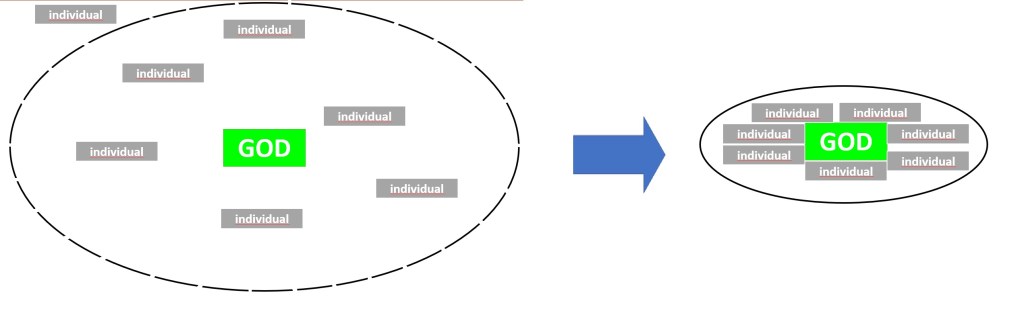
Figure 2: Macro scale. The figure on the left shows the community in a state of striving towards God. Individuals are at varying distances from God, presenting varying levels of advancement in virtue. There are also Christians “by name” (strangers), who are on the periphery of the community, which does not yet have compactness and clearly defined boundaries (dashed line). The figure on the right illustrates the Gnostic community, where the community is concentrated tightly around God. The inner boundaries disappear almost completely, but the external boundaries of the community are instead clearly defined.
4. CONCLUSION
Clement’s Stromateis are usually analysed in theological, historical or philosophical contexts. Particularly, the project of Christian perfection is seen in a strictly individualistic view. Through individual heroic effort, the gnostic, model Christian is able to reach gnosis and acquire affinity to God. He or she may do it within the community, and everyone can become a model Christian regardless of occupation, gender, race (barbarians), or family status (marriage). Thus far, no study has focused on extrapolating the individualistic model of gnostic onto the Christian community and presenting the ultimate consequences of Clement’s ideas at the level of such an assembly. The vision of community presented in Stromateis is not straightforward; it is not fully written down but rather is scattered and “hidden,” yet possible to reconstruct. Such a reconstruction and interpretation was the aim of this paper. The emergent vision of Christian community is of a strongly idealistic nature. Despite its clear practical bent (stress on mixing ordinary life with spiritual development or even the necessity of such a mixture), ultimately it is a philosophical concept, a utopian project. It reveals the longing for the original human community, the original unity of the community of equals (“as it was in the beginning, now and always”). Clement seems to have assumed that the community would ultimately include all of humanity, as evidenced by his inclusion of barbarians as potential members of the community. It is clear, however, that his project was firmly rooted in the microcosm of the early Christian geographically separated communes—his vision constructs interpersonal relations on the basis of the coexistence of a small community and is elitist in its very nature.
Clement stresses that it is in the real (not nominal) community that the individual is able to achieve fulfilment, which in the Christian vision equals salvation. The originality of Clement’s thought lies above all in his appreciation of the community element—it is not the isolated, meditating, fasting, pious individual who is the ideal, but the one who cultivates virtue in the course of interaction with others. Virtue cultivated outside the community of believers is in most cases sterile—it is the community of believers that brings one closer to God and through divine agape brings one closer to other people. Others, in Clement’s vision, are necessary for salvation, as the virtues that lead to it are strictly social ones, i.e., they only truly manifest themselves in everyday interactions with other people. One might even say that it is the community that makes the individual human, and only humans can be saved.
The ultimate conclusion of Clement’s vision would be ekklesia gnostike, the community of gnostics who, thanks to reciprocal interactions with others, have perfected themselves in virtues and have achieved such close unity with God (Christ-Logos) thanks to agape and gnosis, which reduce distance to deity, that they are closer to other people. The closer one is to God, the closer one is to others, as they all constitute one in God. The ekklesia gnostike is so dense and unanimous and uniform that its members are a unity with God. The Christian community should direct itself toward God, and the ultimate goal of such a process of perfecting is the complete annihilation of all barriers between God and people and thanks to this between people who all participate in the love and knowledge of God. Thus, such an ideal Christian community would virtually become a God Himself, as its distance from God would be close to zero.
Bibliography
Clement of Alexandria. Stromateis, books one to three. Translated by John Ferguson. Washington, D.C.: Catholic University of America Press, 2005.
Ashwin-Siejkowski, Piotr. Clement of Alexandria: A Project of Christian Perfection. New York: Bloomsbury, 2008.
Brown, Peter. The Body and Society: Men, Women and Sexual Renunciation in Early Christianity. London – Boston: Faber and Faber, 1988.
Chadwick, Henry. Early Christian Thought and the Classical Tradition. Oxford: Oxford University Press, 1984.
Clement of Alexandria. The Stromata. Translated by Philip Schaff, retrieved from http://www.documentacatholicaomnia.eu/03d/0150-0207,_Clemens_Alexandrinus,_Stromata_[Schaff],_EN.pdf
Drączkowski, Franciszek. Kościół-Agape według Klemensa Aleksandryjskiego [Church-Agape according to Clement of Alexandria]. Lublin: Wydawnictwo KUL, 1996.
Durkheim, Émile. The Elementary Forms of Religious Life. New York – London – Toronto – Sydney – Tokyo – Singapore: The Free Press, 1995.
Itter, Andrew. Esoteric Teaching in Stromateis of Clement of Alexandria. Leiden–Boston: Brill, 2009.
Osborn, Eric. Clement of Alexandria. Cambridge: Cambridge University Press, 2006.
[i] For the purposes of this paper, I have used the editions: Clement of Alexandria, Stromateis, books one to three. Translated by John Ferguson (Washington, D.C.: Catholic University of America Press, 2005) (for books 1 to 3) and Clement of Alexandria, The Stromata. Translated by Philip Schaff, retrieved from http://www.documentacatholicaomnia.eu/03d/0150-0207,_Clemens_Alexandrinus,_Stromata_[Schaff],_EN.pdf (for book 4); further quotes will be marked only with a Roman number denoting the number of the book and Arabic numbers giving the detailed address of the fragment.
[ii] See the description of the whole discussion over the problem of Stromateis versus Didaskalos in Itter, Esoteric Teaching in Stromateis, 15-32.
[iii] Drączkowski, Kościół-Agape według Klemensa, 45.
[iv] More about philosophical inspirations of Clement in Ashwin-Siejkowski, Clement of Alexandria, 79-108 and Chadwick, Early Christian, 31-65. Cf. Osborn, Clement of Alexandria, 91-94 on the relation between philosophy and the Bible.
[v] 1 Corinthians 1:27 according to KJ21.
[vi] E.g., IV.164.5: “neither is the soul good by nature, nor, on the other hand, is the body bad by nature”; III.103.3: “Without the body, how could dispensation for us, the Church, achieve its end?”
[vii] More about Clement’s Christology see Ashwin-Siejkowski, Clement of Alexandria, 147-188.
[viii] As a serious scholar of ancient Christianity, Chadwick, once wrote, “at times it seems that Clement is almost anxious that nothing should be too clear” (Chadwick, Early Christian Thought, 31). One has the impression that in Stromateis almost everything is connected with everything and everything results from everything, giving different conclusions in different places. Clement drifts freely through the themes, returning occasionally to certain themes in order to say something different or to make certain issues more specific, changing their overtones.
[ix] This principle first appeared in Stoic thought and concerns the interdependence and simultaneous coexistence of all moral values, see Diogenes Laertios, VII,125.
[x] Clement creates different variants of chains of virtues, which never form a fully coherent concept, but always have faith at their beginning.
[xi] See cf. 1 J 5,3 according to KJ: “For this is the love of God, that we keep his commandments”.
[xii] This conviction is probably derived from Aristotle’s ethics (Magna Moralia, I,19).
[xiii] Clement goes so far in this that he extends the concept of human nature even to barbarians (IV.8), which was rare in his time.
[xiv] The first two paths, the Gnostic one contains ex definitione, the third implies it because of the capacity of the notion of “work,” and it joins with the martyr’s in the hour of trial, for which the gnostic must always be prepared.
[xv] Here Clement lists four which are the cause of all the others, love for women, fame, power and material things (greed).
[xvi] The apostles were the exception, through their personal relationship with Jesus and the filling of the Spirit.
[xvii] Brown, The Body and Society, 124-125.
[xviii] Drączkowski, Kościół-Agape według Klemensa, 66.
[xix] Drączkowski, Kościół-Agape według Klemensa, 115.
[xx] Drączkowski, Kościół-Agape według Klemensa, 114.
[xxi] However, in order not to go too far, he concludes the statement by saying: “yet in every respect they [men] are ahead of women (IV.62.4). Clement limits himself in his egalitarian zeal in order to remain faithful to the theses of his master, St Paul (see 1 Cor 11:3).
[xxii] Cf. the commandment of love (Mt 22:37-39), which states that we should love our neighbour in the same way as oneself. If a member of the community with other individuals is to be bound by bonds of friendship, then individuals must also treat themselves as their friends. If individuals are enemies to themselves and if they should treat others as themselves, then the constitution of any community based on mutual friendship is impossible.
[xxiii] Drączkowski, Kościół-Agape według Klemensa, 100.
[xxiv] French sociologist Émile Durkheim came to similar conclusion but in the context of Australian aborigines totemism. See Durkheim, The Elementary Forms…
 MARIUSZ FINKIELSZTEIN, Ph.D.